
CompTIA certification XK0-005 exam is the first step for the IT employees to set foot on the road to improve their job. Passing CompTIA Certification XK0-005 Exam is the stepping stone towards your career peak. BraindumpStudy can help you pass CompTIA certification XK0-005 exam successfully.
To become certified, candidates must pass the CompTIA XK0-005 exam, which is available in English, Japanese, and Portuguese. XK0-005 exam is intended for IT professionals who have at least 12 months of experience working with Linux systems, as well as a basic understanding of computer hardware and networking concepts.
CompTIA Linux+ certification exam consists of multiple-choice questions and performance-based simulations. XK0-005 exam duration is 90 minutes, and the passing score is 720 out of 900. XK0-005 Exam Fee is $329, and the certification is valid for three years. CompTIA Linux+ Certification Exam certification renewal requires the completion of 50 Continuing Education Units (CEUs) or retaking the exam. Overall, the CompTIA Linux+ certification is a valuable asset for IT professionals who want to advance their careers in Linux systems administration.
You can trust the XK0-005 practice test and start this journey with complete peace of mind and satisfaction. The XK0-005 exam PDF questions will not assist you in CompTIA Linux+ Certification Exam (XK0-005) exam preparation but also provide you with in-depth knowledge about the CompTIA Linux+ Certification Exam (XK0-005) exam topics. This knowledge will be helpful to you in your professional life. So CompTIA Linux+ Certification Exam (XK0-005) exam questions are the ideal study material for quick CompTIA XK0-005 exam preparation.
NEW QUESTION # 557
An administrator needs to look at a log for an application on a systemd-based system. There is no log for this application in /var/log. Which of the following is another way to view the application log on this system?
Answer: B
Explanation:
https://www.digitalocean.com/community/tutorials/how-to-use-journalctl-to-view-and-manipulate- systemd-logs
NEW QUESTION # 558
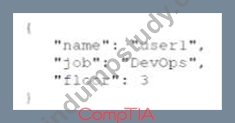
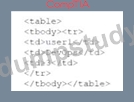
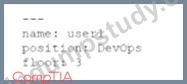
Which of the following data structures is written in JSON?

Answer: A
Explanation:
Option C is the only data structure that is written in JSON format. JSON stands for JavaScript Object Notation, and it is a lightweight and human-readable data interchange format. JSON uses curly braces to enclose objects, which consist of key-value pairs separated by commas. JSON uses square brackets to enclose arrays, which consist of values separated by commas. JSON supports six data types: strings, numbers, booleans, null, objects, and arrays. Option C follows these rules and syntax of JSON, while the other options do not. Option A is written in XML format, which uses tags to enclose elements and attributes. Option B is written in YAML format, which uses indentation and colons to define key-value pairs. Option D is written in INI format, which uses sections and equal signs to define key-value pairs. References: CompTIA Linux+ (XK0-005) Certification Study Guide, Chapter 21: Automating Tasks with Ansible, page 591.
NEW QUESTION # 559
After system startup, the X Window System GUI login interface is not displaying. Which of the following commands ensures that the GUI is started during the system startup process?
Answer: A
Explanation:
To make the system boot into GUI mode by default, use:
bash
systemctl set-default graphical.target
This sets thedefault target(similar to runlevel 5) to start the GUI.
* isolate immediately switches to the GUI target but doesn't persist.
* unmask and enable are only useful if the service is known and named xwindow.service, which is usually not the case (it's typically gdm, lightdm, or graphical.target).
Reference:CompTIA Linux+ XK0-005 Official Study Guide, Domain 4.0 - System Management
"Use systemctl set-default graphical.target to set the GUI as the default boot target."
NEW QUESTION # 560
Application code is stored in Gil. Due to security concerns, the DevOps engineer does not want to keep a sensitive configuration file, app.conf, in the repository. Which of the following should the engineer do to prevent the file from being uploaded to the repository?
Answer: A
Explanation:
This will prevent the file app.conf from being tracked by Git and uploaded to the repository.
The .gitignore file is a special file that contains patterns of files and directories that Git should ignore. Any file that matches a pattern in the .gitignore file will not be staged, committed, or pushed to the remote repository. The .gitignore file should be placed in the root directory of the repository and committed along with the other files.
NEW QUESTION # 561
A systems administrator wants to install a new application that requires the newmod kernel module. Which of the following commands should the systems administrator use?
Answer: C
Explanation:
Use the modprobe command to add or remove modules on Linux. The command works intelligently and adds any dependent modules automatically. The kernel uses modprobe to request modules. The modprobe command searches through the standard installed module directories to find the necessary drivers.
NEW QUESTION # 562
......
You are in a quest for high quality practice materials like our XK0-005 preparation exam. We avail ourselves of this opportunity to approach you to satisfy your needs. In order to acquaint you with our XK0-005 practice materials, we wish to introduce a responsible company dealing with exclusively in area of XK0-005 training engine and it is our company which keeps taking care of the readers' requests, desires and feeling about usage of our XK0-005 study questions in mind.
Latest XK0-005 Exam Tips: https://www.braindumpstudy.com/XK0-005_braindumps.html
