
It is not a time to get scared of taking any difficult certification exam such as Marketing-Cloud-Intelligence. The excellent study guides, practice questions and answers and dumps offered by TestsDumps are your real strength to take the test with confidence and pass it without facing any difficulty. Passing an Marketing-Cloud-Intelligence exam rewards you in the form of best career opportunities. A profile rich with relevant credentials opens up a number of career slots in major enterprises. TestsDumps's Marketing-Cloud-Intelligence Questions and answers based study material guarantees you career heights by helping you pass as many exams as you want.
| Topic | Details |
|---|---|
| Topic 1 |
|
| Topic 2 |
|
| Topic 3 |
|
| Topic 4 |
|
| Topic 5 |
|
| Topic 6 |
|
| Topic 7 |
|
| Topic 8 |
|
| Topic 9 |
|
| Topic 10 |
|
| Topic 11 |
|
>> Marketing-Cloud-Intelligence Valid Examcollection <<
With our numerous advantages of our Marketing-Cloud-Intelligence latest questions and service, what are you hesitating for? Our company always serves our clients with professional and precise attitudes on our Marketing-Cloud-Intelligence exam questions, and we know that your satisfaction is the most important thing for us. We always aim to help you pass the Marketing-Cloud-Intelligence Exam smoothly and sincerely hope that all of our candidates can enjoy the tremendous benefit of our Marketing-Cloud-Intelligence exam material, which might lead you to a better future! And the high pass rate of Marketing-Cloud-Intelligence learning material as 99% to 100% won't let you down.
NEW QUESTION # 10
A technical architect is provided with the logic and Opportunity file shown below:
The opportunity status logic is as follows:
For the opportunity stages "Interest", "Confirmed Interest" and "Registered", the status should be "Open".
For the opportunity stage "Closed", the opportunity status should be closed Otherwise, return null for the opportunity status.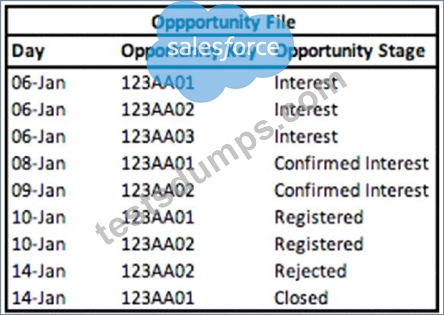
Given the above file and logic and assuming that the file is mapped in a generic data stream type with the following mapping
"Day" - Standard "Day" field
"Opportunity Key" > Main Generic Entity Key
"Opportunity Stage" + Generic Entity Key 2
A pivot table was created to present the count of opportunities in each stage. The pivot table is filtered on Jan
7th - 11th. Which option reflects the stage(s) the Opportunity key 123AA01 is associated with?
Answer: D
Explanation:
Analyzing the Opportunity file with a filter set from January 7th to 11th, Opportunity Key '123AA01' appears under 'Interest' on January 6th and 8th, and under 'Registered' on January 10th. Therefore, during the specified date range, Opportunity Key '123AA01' is associated withboth 'Interest' and 'Registered' stages. Salesforce Marketing Cloud Intelligence provides the capability to map and track opportunity stages over time, allowing for historical stage tracking and reporting. This answer aligns with the ability to use pivot tables to filter and display data by specific attributes and timeframes, as outlined in the Salesforce Marketing Cloud Intelligence documentation.
NEW QUESTION # 11
A client has integrated data from Facebook Ads. Twitter ads, and Google ads in marketing Cloud intelligence. For each data source, the source, the data follows a naming convensions as ...
Facebook Ads Naming Convention - Campaign Name:
CampID_CampName#Market_Object#object#targetAge_TargetGender
Twitter Ads Naming Convention- Media Buy Name
MarketTargeAgeObjectiveOrderID
Google ads Naming Convention-Media Buy Name:
Buying_type_Market_Objective
The client wants to harmonize their data on the common fields between these two platforms (i.e. Market and Objective) using the Harmonization Center. Given the above information, which statement is correct regarding the ability to implement this request?
wet Me - Given the above information, which statement i 's Correct regarding the ability to implement this request?
Answer: A
Explanation:
Despite the different naming conventions, harmonization is possible using patterns in the Harmonization Center. By extracting the 'Market' and 'Objective' components from the naming conventions of each platform, three separate patterns would be created to map these common fields consistently across the data from Facebook Ads, Twitter Ads, and Google Ads.
NEW QUESTION # 12
Source 3: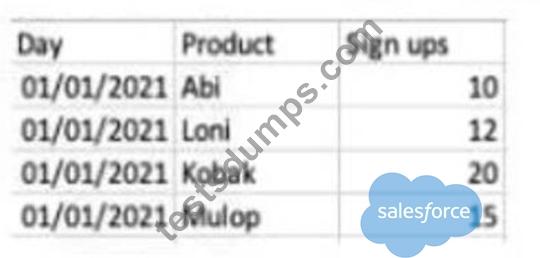
Via the harmonization Center, the Client has created Patterns and applied a classification rule using source 2.
While performing QA, you have spotted that the final value of clicks for Product Group Ais 10, where it should've been i5.
How can an implementation engineer fix this discrepancy?
Answer: B
Explanation:
Case Sensitivity Issue:
The discrepancy in the "Clicks" value for Product Group A (10 instead of 15) likely arises from a mismatch caused by case sensitivity in the classification rules. If some data entries use different capitalization (e.g., "Product Group A" vs. "product group a"), the system might treat them as distinct entries, leading to incorrect aggregations.
Solution:
By unchecking the "Case Sensitive" checkbox, the harmonization process will treat entries with different capitalization as the same value. This ensures consistent classification and resolves discrepancies in aggregated metrics like "Clicks."
NEW QUESTION # 13
A technical architect is provided with the logic and Opportunity file shown below:
The opportunity status logic is as follows:
For the opportunity stages "Interest", "Confirmed Interest" and "Registered", the status should be "Open".
For the opportunity stage "Closed", the opportunity status should be closed.
Otherwise, return null for the opportunity status.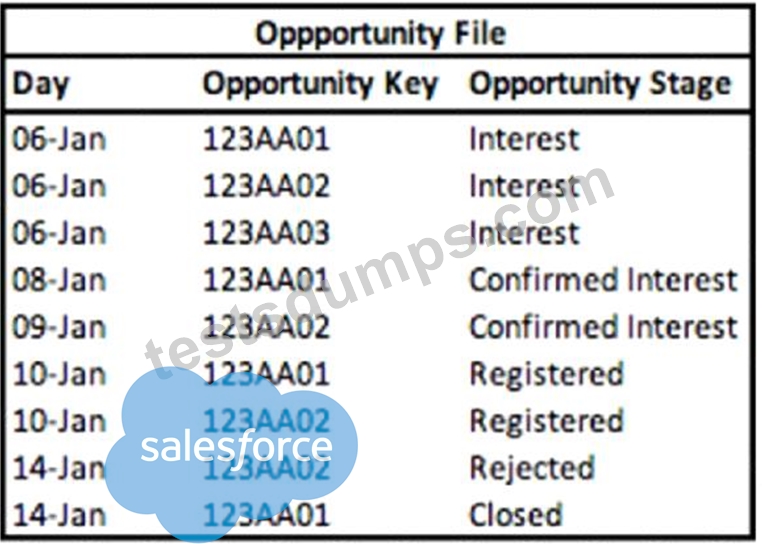
Given the above file and logic and assuming that the file is mapped in a GENERIC data stream type with the following mapping:
"Day" - Standard "Day" field
"Opportunity Key" > Main Generic Entity Key
"Opportunity Stage" - Generic Entity Key 2
"Opportunity Count" - Generic Custom Metric
A pivot table was created to present the count of opportunities in each stage. The pivot table is filtered on Jan
7th - 10th. How many different stages are presented in the table?
Answer: D
Explanation:
Based on the Opportunity file and considering the filter dates from January 7th to 10th, the different stages presented are 'Interest', 'Confirmed Interest', and 'Registered'. This makes a total of 3 different stages that would be presented in the pivot table. Salesforce Marketing CloudIntelligence allows for the creation of pivot tables that can display counts of entities across different dimensions, in this case, Opportunity Stages.
Reference to Salesforce Marketing Cloud Intelligence documentation that covers data mapping and pivot table creation would support this conclusion.
NEW QUESTION # 14
A client's data consists of three data streams as follows:
Data Stream A: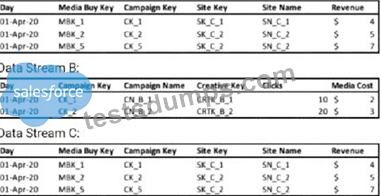
* The data streams should be linked together through a parent-child relationship.
* Out of the three data streams, Data Stream C is considered the source of truth for both the dimensions and measurements.
How should the "Override Media Buy Hierarchies" checkbox be set in order to meet the client's requirements?
Answer: A
Explanation:
If Data Stream C is the source of truth, the "Override Media Buy Hierarchies" checkbox should be checked for Data Stream C. This means that the hierarchy defined within Data Stream C will take precedence over any other media buy hierarchies present in Data Streams A or B. By doing so, it enforces that the hierarchy from the source of truth (Data Stream C) is used throughout the dataset, maintaining the integrity of the hierarchical relationships as defined by the most reliable data source.
NEW QUESTION # 15
......
TestsDumps offers actual Marketing Cloud Intelligence Accredited Professional Exam Exam Questions that make your success possible on the first try. TestsDumps has helped many customers gain high scores. Before purchasing, you can download and try any Marketing-Cloud-Intelligence Exam Questions format. Marketing Cloud Intelligence Accredited Professional Exam Marketing-Cloud-Intelligence with excellect pass rate.
Latest Marketing-Cloud-Intelligence Dumps Ppt: https://www.testsdumps.com/Marketing-Cloud-Intelligence_real-exam-dumps.html
