
Our Pass4sures provides the latest and the most complete CSP-Assessor exam questions and answers aimed at becoming the most reliable dumps provider in IT exam software. With the help of our Pass4sures, nearly all those who have purchased our dumps have successfully passed the difficult CSP-Assessor Exam, which gives us great confidence to recommend our reliable products to you. We can assure you that we will fully refund the cost you purchased our dump, if you fail CSP-Assessor exam with our dumps. So, just rest assured to prepare for your exam.
No study materials can boost so high efficiency and passing rate like our CSP-Assessor exam reference when preparing the test CSP-Assessor certification. Our CSP-Assessor exam practice questions provide the most reliable exam information resources and the most authorized expert verification. Our test bank includes all the possible questions and answers which may appear in the real exam and the quintessence and summary of the exam papers in the past. We strive to use the simplest language to make the learners understand our CSP-Assessor Exam Reference and passed the CSP-Assessor exam.
>> CSP-Assessor Exam Overviews <<
Before we start develop a new CSP-Assessor study materials, we will prepare a lot of materials. After all, we must ensure that all the questions and answers of the CSP-Assessor study materials are completely correct. First of all, we have collected all relevant reference books. Most of the CSP-Assessor Study Materials are written by the famous experts in the field. They are widely read and accepted by people. Through careful adaption and reorganization, all knowledge will be integrated in our CSP-Assessor study materials.
| Topic | Details |
|---|---|
| Topic 1 |
|
| Topic 2 |
|
| Topic 3 |
|
NEW QUESTION # 96
The Swift HSM boxes: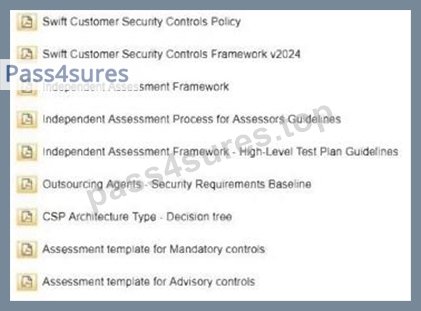
Answer: A
NEW QUESTION # 97
The Swift user has an sFTP server to push files to an outsourcing agent hosting the Swift users own Communication interface. What is their architecture type?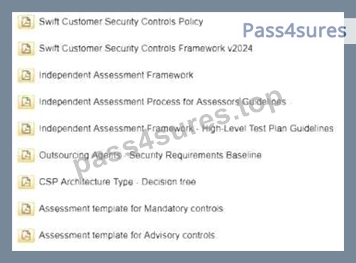
Answer: A
Explanation:
This question requires identifying the architecture type based on the SWIFT CSP Architecture Types (defined in CSCF documentation) for a user with an sFTP server pushing files to an outsourcing agent hosting the Communication Interface:
* Step 1: Define the Scenario
* The SWIFT user uses an sFTP server to transfer files to an outsourcing agent, which hosts the user's Communication Interface (e.g., SWIFT Alliance Gateway). The Communication Interface connects to the SWIFT network.
* Step 2: SWIFT Architecture Types Overview
* A1: Full in-house stack (Messaging Interface, Communication Interface, etc.).
* A3: Communication Interface hosted by a service provider/outsourcing agent; back-office or middleware connects to it.
* A4: Both Messaging and Communication Interfaces hosted by a service provider.
* B: Alliance Lite2 (direct cloud-based connectivity).
NEW QUESTION # 98
Which ones are Alliance Lite2 key components? (Choose all that apply.)
Answer: B,C,D
NEW QUESTION # 99
When hesitant on the applicability of a CSCF control to a particular component? What steps should you take? (Choose all that apply.)
Answer: A,B,C,D
NEW QUESTION # 100
The SWIFT HSM Box must be hardened at the system level by the SWIFT user owning the equipment.
*Swift Customer Security Controls Policy
*Swift Customer Security Controls Framework v2025
*Independent Assessment Framework
*Independent Assessment Process for Assessors Guidelines
*Independent Assessment Framework - High-Level Test Plan Guidelines
*Outsourcing Agents - Security Requirements Baseline v2025
*CSP Architecture Type - Decision tree
*CSP_controls_matrix_and_high_test_plan_2025
*Assessment template for Mandatory controls
*Assessment template for Advisory controls
*CSCF Assessment Completion Letter
*Swift_CSP_Assessment_Report_Template
Answer: B
Explanation:
The Hardware Security Module (HSM) Box is a critical component for managing cryptographic keys in the SWIFT environment. Hardening at the system level involves securing the HSM's operating system and configuration against vulnerabilities. Let's evaluate:
*CSCF Control "2.3 System Hardening" mandates that all SWIFT-related systems, including the HSM Box, be hardened to reduce the attack surface. This is the responsibility of the SWIFT user owning the equipment, as outlined in the "Swift Customer Security Controls Framework v2025."
*The "Assessment template for Mandatory controls" requires users to demonstrate hardening of owned HSMs, including patching, disabling unused services, and enforcing access controls.
*If the HSM is owned by the user (e.g., in an on-premises A1 or A2 architecture), the user must perform hardening. This differs from cloud deployments (e.g., A4), where the provider may handle it, but the question specifies user-owned equipment.
Summary of Correct answer:
The SWIFT user owning the HSM Box must harden it at the system level (TRUE).
References to SWIFT Customer Security Programme Documents:
*Swift Customer Security Controls Framework v2025: Control 2.3 requires system hardening.
*Assessment template for Mandatory controls: Specifies user responsibility for owned HSMs.
*CSP_controls_matrix_and_high_test_plan_2025: Includes HSM hardening in assessments.
NEW QUESTION # 101
......
If you prefer to prepare for your exam on paper, then our CSP-Assessor exam materials will be your best choice. CSP-Assessor PDF version is convenient to read and printable, and you can take them with you, and you can practice them anywhere and anyplace. Besides, free demo for CSP-Assessor PDF version is available, and you can try before buying. We are pass guarantee and money back guarantee and if you fail to pass the exam. You can receive the downloading link and password for CSP-Assessor Training Materials within ten minutes for CSP-Assessor exam materials, if you don’t receive, you can contact with us, and we will solve the problem for you.
CSP-Assessor Exam Torrent: https://www.pass4sures.top/Customer-Security-Programme-CSP/CSP-Assessor-testking-braindumps.html
