
Die Produkte von DeutschPrüfung sind zuverlässig und von guter Qualität. Sie können im Internet teilweise die Demo zur Netskope NSK300 Zertifizierungsprüfung kostenlos als Probe herunterladen. Nach dem Benutzen, meine ich, werden Sie mit unseren Produkten zufrieden sein. Weshalb zögern Sie noch, wenn es so gute Produkte zum Bestehen der Netskope NSK300 Prüfung gibt. Schicken Sie doch schnell die Produkte von DeutschPrüfung in den Warenkorb.
DeutschPrüfung ist der beste Katalysator für den Erfolg der IT-Fachleute, Viele Kandidaten, die Netskope NSK300 IT-Zertifizierungsprüfungen bestanden haben, haben Schulungsunterlagen von DeutschPrüfung benutzt. Unser Expertenteam von DeutschPrüfung hat die neuesten und effizientesten Prüfungsfragen und Antworten zur Netskope NSK300 Zertifizierungsteste.
>> Netskope NSK300 Probesfragen <<
Seit langem bieten wir DeutschPrüfung vielfältige neueste Prüfungsunterlagen zur Netskope NSK300 Zertifizierungsprüfung. Zum Beispiel sind Netskope NSK300 Dumps von DeutschPrüfung laut der neuesten IT-Zertifizierungsprüfung geschaffen. Wir können Ihnen die neusten Informationen über die Netskope NSK300 Prüfungen anbieten. Die Unterlagen beinhalten die veränderten Informationen und die neue Prüfungsfragensformen. So wenn Sie IT-Zertifizierungsprüfung ablegen wollen, sollen Sie am besten die Unterlagen von DeutschPrüfung. Damit können Sie sich besser auf die Netskope NSK300 Prüfungen vorbereiten.
| Thema | Einzelheiten |
|---|---|
| Thema 1 |
|
| Thema 2 |
|
| Thema 3 |
|
| Thema 4 |
|
55. Frage
Review the exhibit.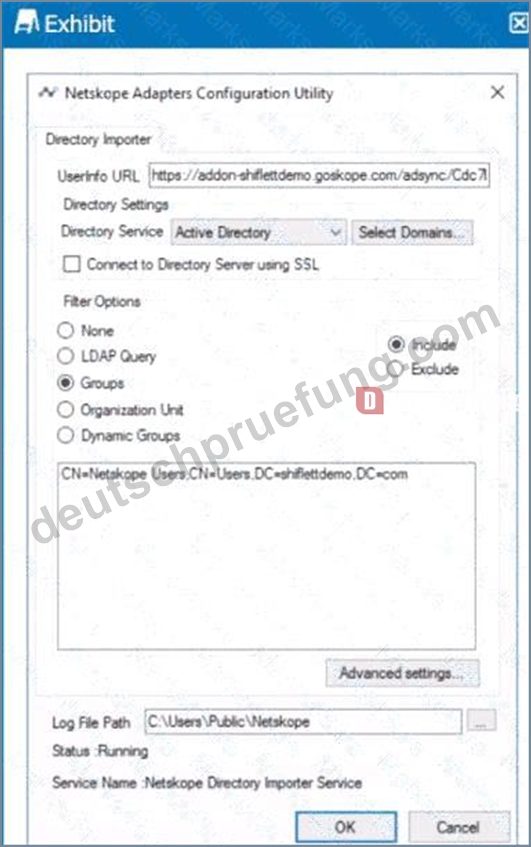
You installed Directory Importer and configured it to import specific groups ot users into your Netskope tenant as shown in the exhibit. One hour after a new user has been added to the domain, the user still has not been provisioned to Netskope.
What are three potential reasons for this failure? (Choose three.)
Antwort: B,C,E
Begründung:
The three potential reasons for the failure of a new user not being provisioned to Netskope an hour after being added to the domain could be:
* B. The server that the Directory Importer is installed on is unable to reach Netskope's add-on endpoint:
If the server cannot connect to Netskope's endpoint, it cannot sync the user data. This could be due to network issues, incorrect configuration, or firewall restrictions1.
* C. The user is not a member of the group specified as a filter: The Directory Importer may be configured to import users from specific groups only. If the new user is not a member of these groups, they will not be imported into Netskope1.
* E. The default collection interval is 180 minutes, therefore a sync may not have run yet: The Directory Importer may be scheduled to sync every 180 minutes. If only an hour has passed, the sync process might not have occurred yet, and the user would not be provisioned until the next sync interval1.
These potential reasons are based on the standard operation and configuration of the Netskope Directory Importer as described in the Netskope Knowledge Portal and documentation
56. Frage
A company's architecture includes a server subnet that is logically isolated from the rest of the network with no Internet access, no default gateway, and no access to DNS. New resources can only be provisioned on virtual resources in that segment and there is a firewall that is tunnel-capable securing the perimeter of the segment. The only requirement is to have content filtering for any server that might access the Internet using a browser.
Which two Netskope deployment methods would achieve this requirement? (Choose two.)
Antwort: B,D
Begründung:
For a server subnet that is isolated and requires content filtering for any server that might access the Internet using a browser, the two Netskope deployment methods that would meet this requirement are:
* B. Deploy Data Plane on Premises (DPoP) with a proxy configuration on the servers: Deploying DPoP would allow the isolated servers to connect to the Netskope cloud for content filtering through a proxy configuration.This setup would enable the servers to have controlled access to the Internet for content filtering purposes without requiring direct Internet access1.
* C. Deploy IPsec or GRE tunnels in the segment to steer traffic from the servers to Netskope: By deploying IPsec or GRE tunnels, the traffic from the servers can be securely directed to Netskope for content filtering.This method is suitable for environments where servers do not have direct Internet access, as the tunnel provides a secure path for traffic to reach Netskope's cloud services1.
These deployment methods are designed to work in environments with strict network isolation and provide the necessary content filtering capabilities for servers accessing the Internet.
The deployment methods and their suitability for isolated server subnets are based on Netskope's documentation and resources, which detail various deployment options and their use cases21.
57. Frage
Your CISO asks that you to provide a report with a visual representation of the top 10 applications (by number of objects) and their risk score. As the administrator, you decide to use a Sankey visualization in Advanced Analytics to represent the data in an efficient manner.
In this scenario, which two field types are required to produce a Sankey Tile in your report? {Choose two.)
Antwort: A,C
Begründung:

To produce a Sankey Tile in a report that visually represents the top 10 applications by number of objects and their risk score, you would need:
Dimension (A): This field type would be used to represent the nodes in the Sankey visualization, which could be the applications in this case1.
Measure (B): This field type would provide the weight of the links between the nodes, representing the number of objects or the risk score associated with each application1.
These two field types are essential for creating a Sankey visualization as they define the structure and flow of data between different stages or categories within the visualization.
58. Frage
You are implementing a solution to deploy Netskope for machine traffic in an AWS account across multiple VPCs. You want to deploy the least amount of tunnels while providing connectivity for all VPCs.
How would you accomplish this task?
Antwort: A
Begründung:
The best approach to deploy Netskope for machine traffic across multiple VPCs in an AWS account with the least amount of tunnels while providing connectivity for all VPCs is to use IPsec tunnels from the AWS Transit Gateway. This method allows you to use the same Site-to-Site VPN connection to Netskope for multiple VPCs, thus minimizing the number of tunnels required12. The AWS Transit Gateway acts as a network transit hub, enabling you to connect your VPCs and on-premises networks through a central point of management and control. Using IPsec tunnels with the AWS Transit Gateway ensures that all VPCs connected to it utilize the same IPsec tunnel between the transit gateway and Netskope POP1.
59. Frage
Review the exhibit.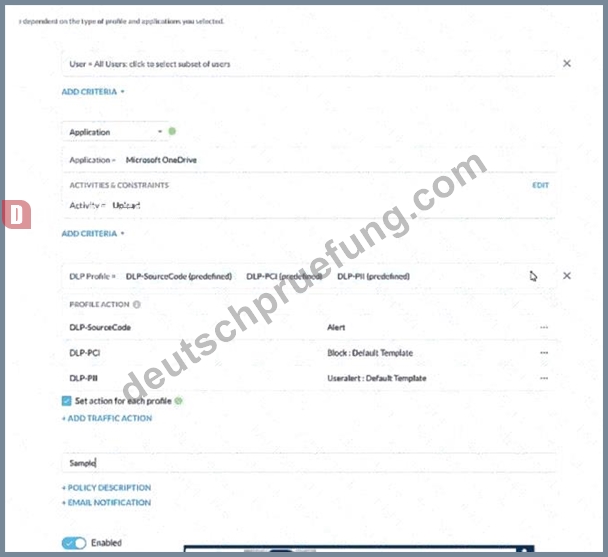
A user has attempted to upload a file to Microsoft OneDrive that contains source code with Pll and PCI data.
Referring to the exhibit, which statement Is correct?
Antwort: C
60. Frage
......
Die Zertifizierungsprüfung von Netskope NSK300 ist ein unerlässlicher Teil im IT-Bereich. Aber wie kann man in kurzer Zeit bessere Resulate bei weniger Einsatz erzielen? DeutschPrüfung ist Ihre beste Wahl. Die Schulungsunterlagen zur Netskope NSK300 Zertifizierungsprüfung von DeutschPrüfung sind von erfahrenen IT-Experten entworfen, deren Korrktheit zweifellos ist. Wenn Sie noch besorgt sind, können Sie einen Teil von den kostenlosen Testaufgaben und Antworten herunterladen, bevor Sie die Schulungsunterlagen von DeutschPrüfung benutzen.
NSK300 Online Prüfung: https://www.deutschpruefung.com/NSK300-deutsch-pruefungsfragen.html
