
P.S. Free & New DP-100 dumps are available on Google Drive shared by ExamcollectionPass: https://drive.google.com/open?id=1BzMgV-qU4ehqFefS9VRlKCg_QTAmgvTc
And you can also use the Microsoft DP-100 PDF on smart devices like smartphones, laptops, and tablets. The second one is the web-based Microsoft DP-100 practice exam which can be accessed through the browsers like Firefox, Safari, and Google Chrome. The customers don't need to download or install excessive plugins or software to get the full advantage from web-based DP-100 Practice Tests.
Passing the test DP-100 certification can prove you are that kind of talents and help you find a good job with high pay and if you buy our DP-100 guide torrent you will pass the exam successfully. Our product boosts many merits and useful functions to make you to learn efficiently and easily. Our DP-100 guide questions are compiled and approved elaborately by experienced professionals and experts. The download and tryout of our DP-100 Torrent question before the purchase are free and we provide free update and the discounts to the old client. Our customer service personnel are working on the whole day and can solve your doubts and questions at any time.
Preparing for Designing and Implementing a Data Science Solution on Azure (DP-100) exam can be a challenging task, especially when you're already juggling multiple responsibilities. People who don't study with updated Microsoft DP-100 practice questions fail the test and lose their resources. If you don't want to end up in this unfortunate situation, you must prepare with actual and Updated DP-100 Dumps of ExamcollectionPass. At ExamcollectionPass, we believe that one size does not fit all when it comes to Microsoft DP-100 exam preparation. Our team of experts has years of experience in providing Microsoft DP-100 exam preparation materials that help you reach your full potential.
Microsoft DP-100 certification exam is a comprehensive exam that covers a wide range of topics related to data science solutions on Azure. DP-100 exam consists of multiple-choice questions and requires the candidate to demonstrate their knowledge and understanding of data science concepts and Azure data science solutions. DP-100 exam is designed to test the candidate’s ability to design and implement data science solutions on Azure.
Microsoft DP-100 Certification Exam is ideal for data scientists, data analysts, and other professionals who work with data and want to validate their skills and knowledge in data science. It is also suitable for professionals who are looking to transition into the data science field and want to demonstrate their proficiency in this area. Designing and Implementing a Data Science Solution on Azure certification exam can help you stand out in the job market and increase your earning potential.
Achieving the Microsoft DP-100 Certification is a valuable accomplishment for data professionals, as it demonstrates their competency in working with data on the Azure platform. It is also a valuable asset for organizations looking to hire data professionals, as it shows that the candidate has the necessary skills and expertise to design and implement data science solutions using Azure tools and services.
NEW QUESTION # 405
Note: This question is part of a series of questions that present the same scenario. Each question in the series contains a unique solution that might meet the stated goals. Some question sets might have more than one correct solution, while others might not have a correct solution.
After you answer a question in this section, you will NOT be able to return to it. As a result, these questions will not appear in the review screen.
You are analyzing a numerical dataset which contains missing values in several columns.
You must clean the missing values using an appropriate operation without affecting the dimensionality of the feature set.
You need to analyze a full dataset to include all values.
Solution: Replace each missing value using the Multiple Imputation by Chained Equations (MICE) method.
Does the solution meet the goal?
Answer: B
Explanation:
Explanation
Replace using MICE: For each missing value, this option assigns a new value, which is calculated by using a method described in the statistical literature as "Multivariate Imputation using Chained Equations" or
"Multiple Imputation by Chained Equations". With a multiple imputation method, each variable with missing data is modeled conditionally using the other variables in the data before filling in the missing values.
Note: Multivariate imputation by chained equations (MICE), sometimes called "fully conditional specification" or "sequential regression multiple imputation" has emerged in the statistical literature as one principled method of addressing missing data. Creating multiple imputations, as opposed to single imputations, accounts for the statistical uncertainty in the imputations. In addition, the chained equations approach is very flexible and can handle variables of varying types (e.g., continuous or binary) as well as complexities such as bounds or survey skip patterns.
References:
https://www.ncbi.nlm.nih.gov/pmc/articles/PMC3074241/
https://docs.microsoft.com/en-us/azure/machine-learning/studio-module-reference/clean-missing-data
NEW QUESTION # 406
You are performing feature scaling by using the scikit-learn Python library for x.1 x2, and x3 features.
Original and scaled data is shown in the following image.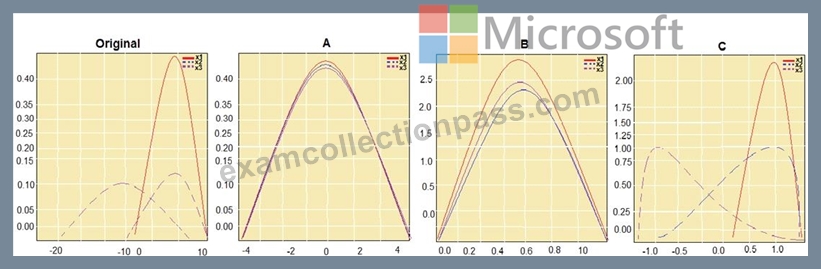
Use the drop-down menus to select the answer choice that answers each question based on the information presented in the graphic.
NOTE: Each correct selection is worth one point.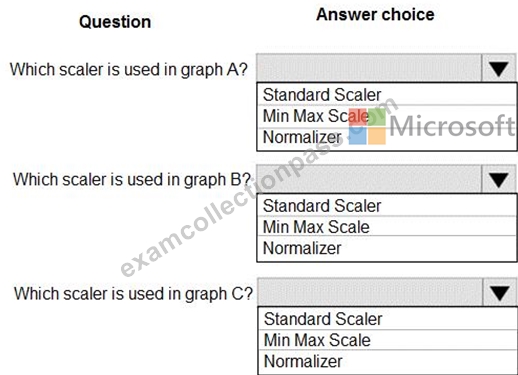
Answer:
Explanation: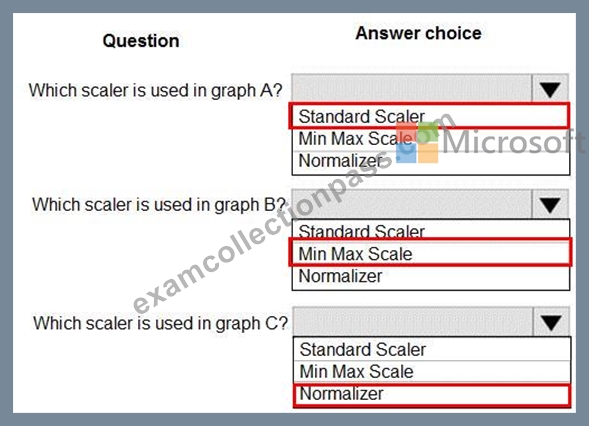
Explanation:
Box 1: StandardScaler
The StandardScaler assumes your data is normally distributed within each feature and will scale them such that the distribution is now centred around 0, with a standard deviation of 1.
Example: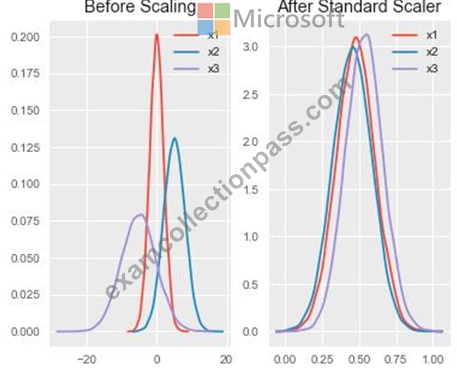
All features are now on the same scale relative to one another.
Box 2: Min Max Scaler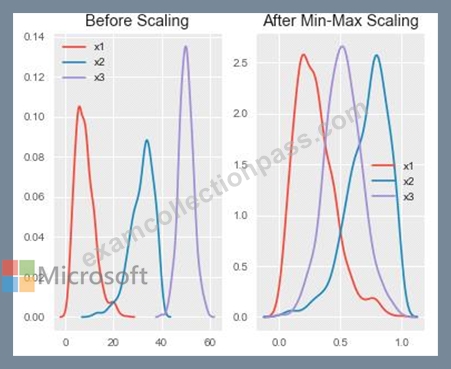
Notice that the skewness of the distribution is maintained but the 3 distributions are brought into the same scale so that they overlap.
Box 3: Normalizer
References:
http://benalexkeen.com/feature-scaling-with-scikit-learn/
NEW QUESTION # 407
You manage an Azure Machine Learning workspace by using the Python SDK v2.
You must create a compute cluster in the workspace. The compute cluster must run workloads and properly handle interruptions. You start by calculating the maximum amount of compute resources required by the workloads and size the cluster to match the calculations.
The cluster definition includes the following properties and values:
* name="mlcluster1''
* size="STANDARD.DS3.v2"
* min_instances=1
* maxjnstances=4
* tier="dedicated"
The cost of the compute resources must be minimized when a workload is active Of idle. Cluster property changes must not affect the maximum amount of compute resources available to the workloads run on the cluster.
You need to modify the cluster properties to minimize the cost of compute resources.
Which properties should you modify? To answer, select the appropriate options in the answer area.
NOTE: Each correct selection is worth one point.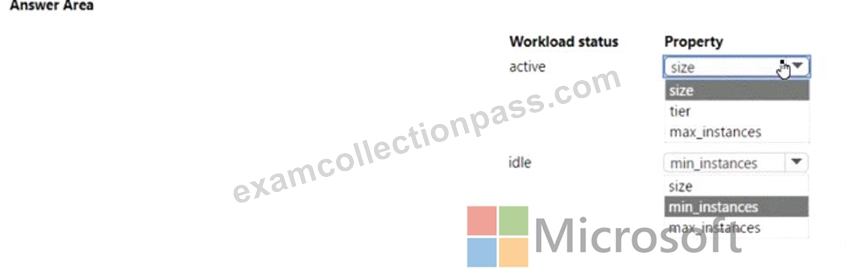
Answer:
Explanation: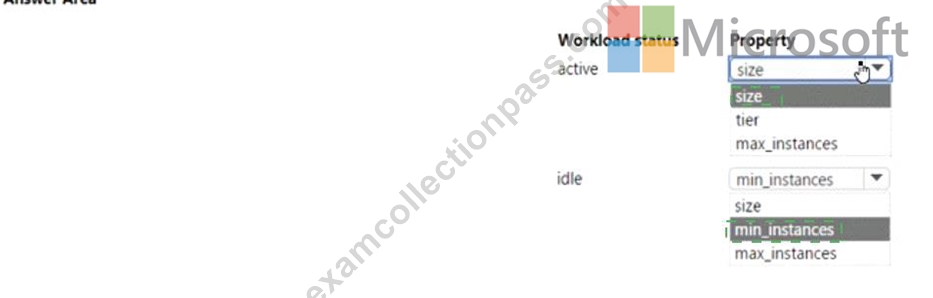
Explanation:
NEW QUESTION # 408
You collect data from a nearby weather station. You have a pandas dataframe named weather_df that includes the following data:
The data is collected every 12 hours: noon and midnight.
You plan to use automated machine learning to create a time-series model that predicts temperature over the next seven days. For the initial round of training, you want to train a maximum of 50 different models.
You must use the Azure Machine Learning SDK to run an automated machine learning experiment to train these models.
You need to configure the automated machine learning run.
How should you complete the AutoMLConfig definition? To answer, select the appropriate options in the answer area.
NOTE: Each correct selection is worth one point.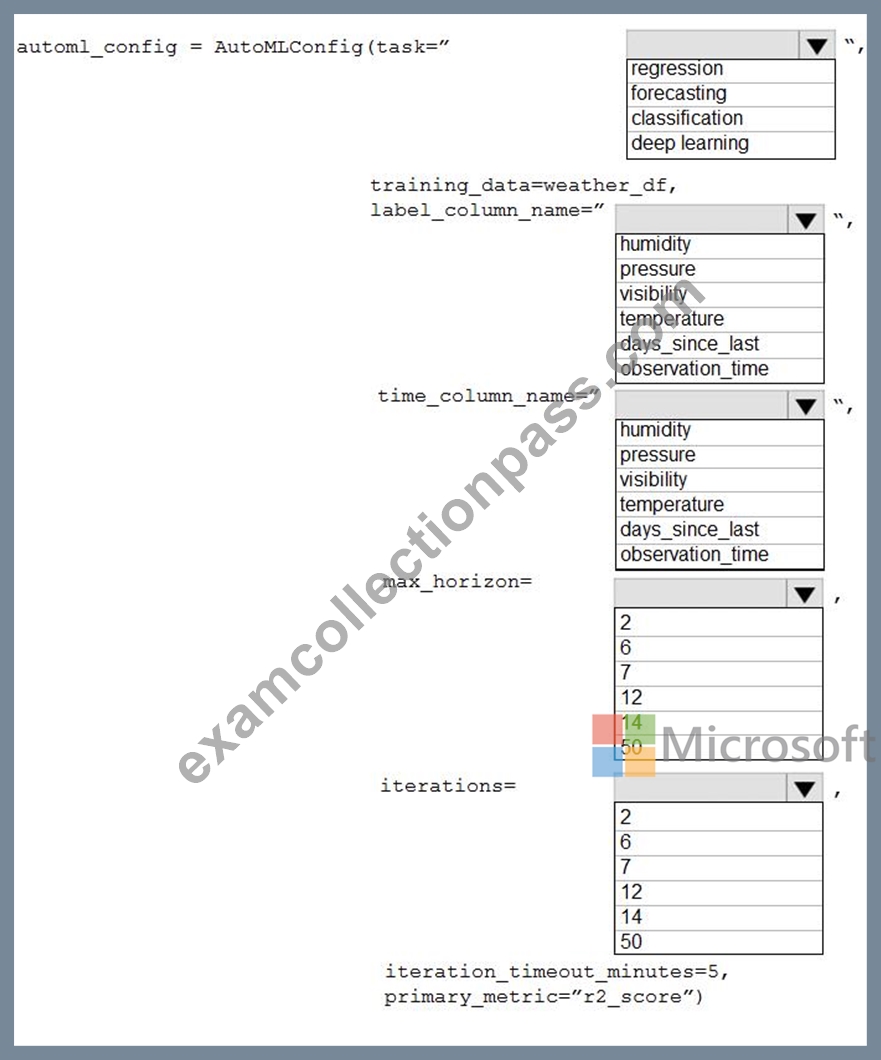
Answer:
Explanation: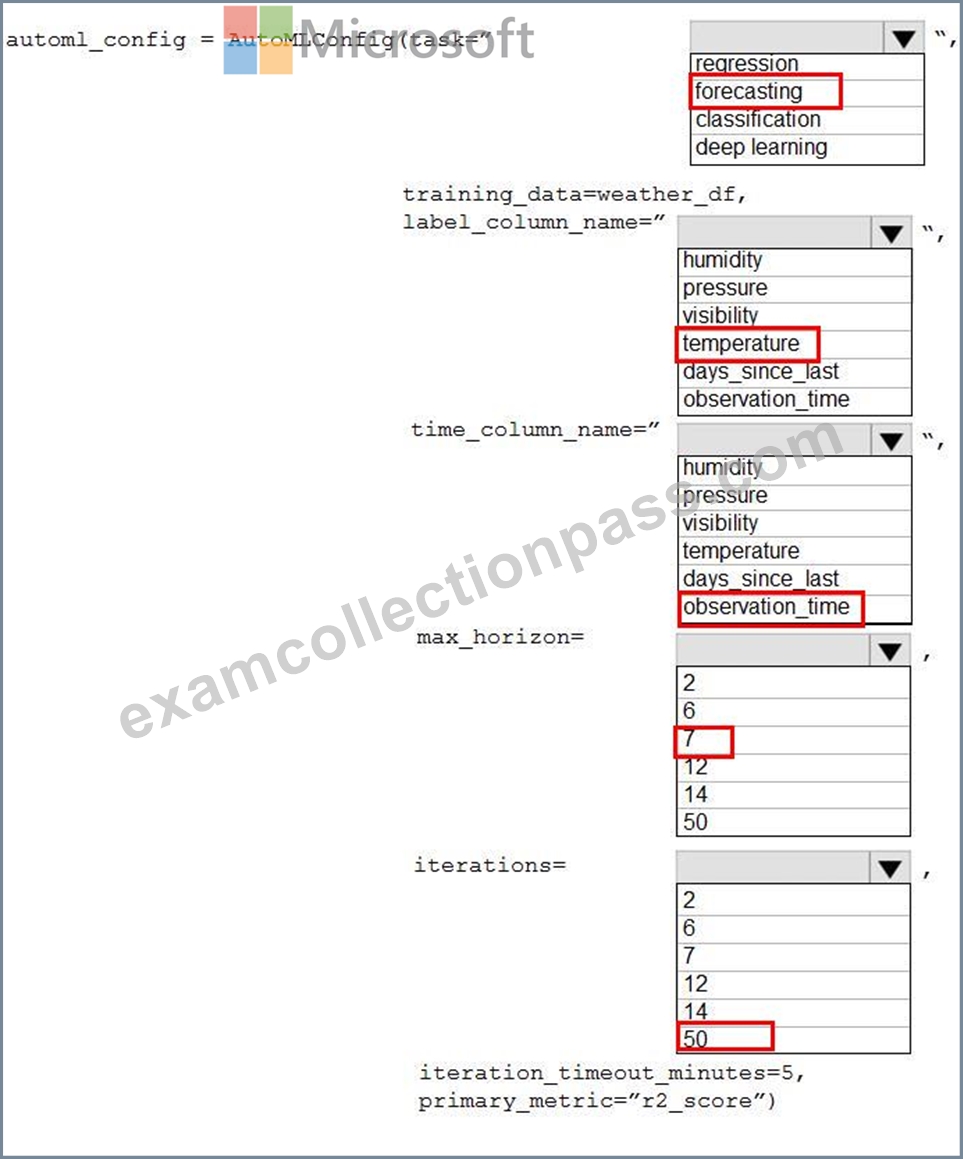
Reference:
https://docs.microsoft.com/en-us/python/api/azureml-train-automl-client/azureml.train.automl.automlconfig.automlconfig
NEW QUESTION # 409
You train a classification model by using a decision tree algorithm.
You create an estimator by running the following Python code. The variable feature_names is a list of all feature names, and class_names is a list of all class names.
from interpret.ext.blackbox import TabularExplainer
You need to explain the predictions made by the model for all classes by determining the importance of all features.
For each of the following statements, select Yes if the statement is true. Otherwise, select No.
NOTE: Each correct selection is worth one point.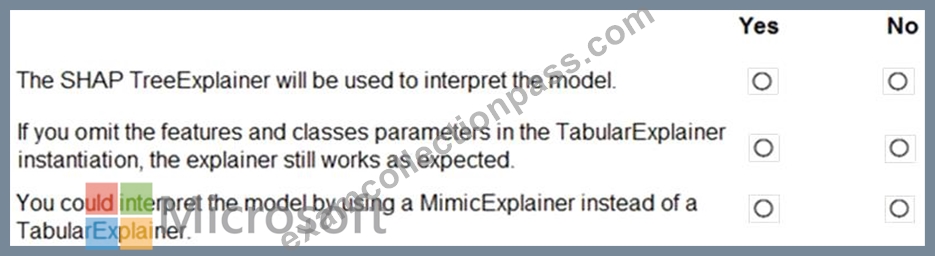
Answer:
Explanation: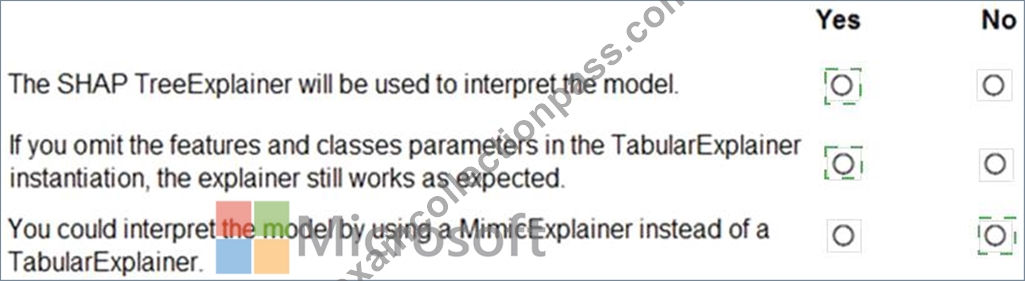
Explanation: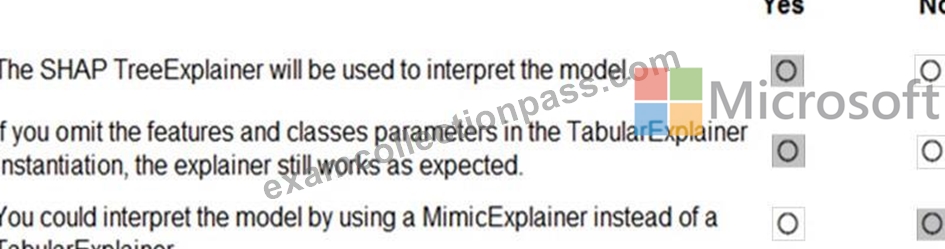
Box 1: Yes
TabularExplainer calls one of the three SHAP explainers underneath (TreeExplainer, DeepExplainer, or KernelExplainer).
Box 2: Yes
To make your explanations and visualizations more informative, you can choose to pass in feature names and output class names if doing classification.
Box 3: No
TabularExplainer automatically selects the most appropriate one for your use case, but you can call each of its three underlying explainers underneath (TreeExplainer, DeepExplainer, or KernelExplainer) directly.
Reference:
https://docs.microsoft.com/en-us/azure/machine-learning/how-to-machine-learning-interpretability-aml
NEW QUESTION # 410
......
There are many merits of our product on many aspects and we can guarantee the quality of our DP-100 practice engine. Firstly, our experienced expert team compile them elaborately based on the real exam and our DP-100 study materials can reflect the popular trend in the industry and the latest change in the theory and the practice. Secondly, both the language and the content of our DP-100 Study Materials are simple,easy to be understood and suitable for any learners.
Vce DP-100 Files: https://www.examcollectionpass.com/Microsoft/DP-100-practice-exam-dumps.html
P.S. Free 2025 Microsoft DP-100 dumps are available on Google Drive shared by ExamcollectionPass: https://drive.google.com/open?id=1BzMgV-qU4ehqFefS9VRlKCg_QTAmgvTc